
Streets make cities: the ingredients of a truly great street
Abstract
This publication is a sequel to Stan Eckstut’s presentation on re-imagining urban sites published by Urban Design Review on August 18, 2025. It is, similarly, in the form of a mini-documentary captured through a video and accompanying transcript. Eckstut uses West 4th Street in New York City’s West Village, albeit a relatively narrow and local street, to highlight the street as a complex, holistic ecosystem that defines the public domain and gives our cities their life and character.
About the Author
City making architect Stan Eckstut has led an urban life and experienced the street since youth. He has devoted his professional career to the making of the public realm with the street at its core. Since his time with the Urban Design Group in the City of New York when it was at its peak, he served as Director of the Urban Design Program at Columbia University and has practiced architecture for over five decades leading large design firms on major urban redevelopments from New York City to Washington, D.C. He is protagonist of the recent mini-documentary video: “Thoughts on Reimagining Urban Sites,” and now: “Streets Make Cities,” both produced by the Pittsburgh History & Landmarks Foundation.
Editor’s Preface
In 1993, Allan B. Jacobs’ seminal book Great Streets was published. This opened our eyes and minds to what makes up great streets, of various sizes and in different locations of the world, to be on and live on. Streets, as Jacobs says, are where you meet and see people and the basic reason to have cities in any case. They are, more than anything else, what make the public realm. A third of a century later, Stan Eckstut re-focuses us on the importance of the street, but in a very different way. Eckstut, literally raised on the street since a boy, loves the life of the street with all its complexity, messiness and visual interest. In his mini-documentary video, he extrapolates exactly what this is and means as we go about designing and redeveloping cities.
Raeburn Chapman, Urban Design Review.
Introduction
This is a second video that tries to help a lay audience understand how cities are made and what makes them tick, and that may be of value to city planners and designers. People often think cities are buildings. Cities, as this film emphasizes, are the streets and the public realm. Buildings are a means for making the public realm – shaping the outdoor spaces that are everyone’s turf. These are the streets as well as parks, plazas and waterfronts where communal life, commerce and civic activity take place.
The most important public realm is the street. This is what I have been emphasizing in all of my work. (As an aside, I now call myself a City Making Architect. I have learnt about this name from architectural firms in Australia, a breakthrough for me.)
The first film was made at the DC Wharf. It focused on four principles that form my approach to creating new districts and significant places. These principles are followed in all my projects.
This “Streets” film tries to make the public realm, one of the four principles, easier to understand. I hope you will enjoy this short film from the Pittsburgh History & Landmarks Foundation on how the people who design our buildings help create whole streetscapes that are part of the character, life and functioning of the city.
My presentation focusses on West 4th which has been a successful NYC street for a long time – a valuable real estate address, a destination for young, middle aged and old, alone and in groups, day and night, in all weather, and a community space. There are always people walking and vehicles moving. At face value West 4th appears simple, modest and functional. It is the same width of street made by the same order of regular block widths and intersecting streets, leads to no special destinations except larger streets, is flat, narrow and straight and is made with regular, simple orthogonal corners. There are no special buildings that stand out in terms of use, height or design. However. it is the whole family of buildings framing the street that make it very beautiful and welcoming and the different street elements that make it workable. The whole is greater than the sum of its parts.
The video
The presentation may be accessed by clicking on the video below titled:
Streets Make Cities
Transcript
Cities are essentially about streets, which is where public life occurs in a city. Most people think about buildings, but it is the street that we see, value most and remember. The street is the key to a building’s value. If I’m in Chicago, I remember Michigan Avenue and if in LA, Wilshire Boulevard. In New York, Broadway and Central Park West.
I am an architect. My practice has always been about making cities, specifically streets. It does not mean that buildings do not have their own identity, individual character and beauty. What however matters is how a family of buildings contribute to making a common place which is the street, the space between the buildings.
I’ve always lived in cities. For the first ten years of my life, I lived above my family’s butcher shop in Philadelphia, one of the great walkable cities of the world. I’ve walked to work all my life. I am probably biased. I love streets.
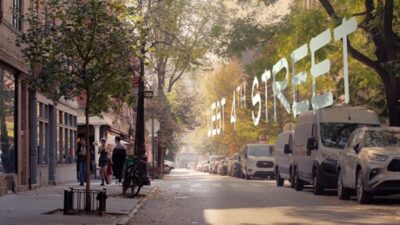
West 4th Street is a great example of a street.
West 4th Street in New York City’s historic West Village is a great example of a street. It is a place we can learn lessons from and apply to many other locations. Buildings of all types have grown up next to each other with the space between the buildings having its own design including nature and trees.
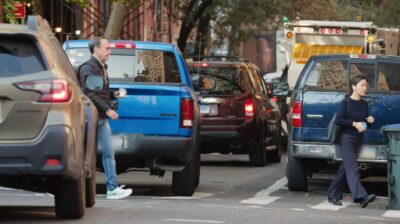
Figure 2: A tug-of-war between people walking and on wheels.
The street is like a tug-of-war between the people walking and the people on wheels who have to drive the trucks and the taxis and try to find a parking space. But that balance, that tug-of-war, is exactly what makes it so special.
The sidewalks may be small and narrow, but so are the streets where cars are moving and parking. It works. Everyone’s welcome and it’s always open day and night, functioning in all weather. The street is our commons, our shared space.
The most important thing you’re going to see are the people, the mix of all types, all ages, sizes and colors. You see the world by just looking at the people. The street is a kind of fashion show.
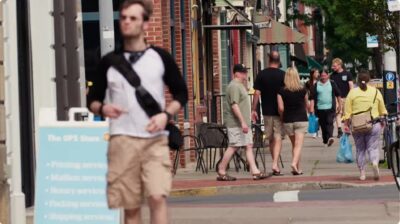
Figure 3: Cities are for walking.
Cities are for walking, which is what the street is primarily designed for. We have been walking in cities from their very beginning. It’s our primary means of getting around. In a good city neighborhood, everything is within a walk, whether it’s school, church, library, gym, park, playground or shops.
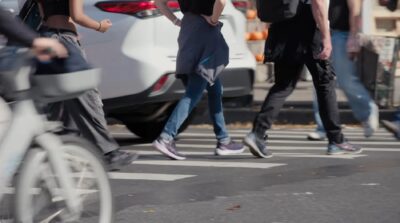
Figure 4: The crosswalk is key to how a city works.
No matter the size of the street, we have to agree on a set of rules, critical to which is the provision of the crosswalk. The crosswalk is probably the key to how a city works every day – how it keeps flowing and moving and how we get about. Crosswalks are simple white lines that are meant to be noticed not only by people walking but by those on bikes and those in vehicles.
Whereas the street is where the battle takes place, the tug-of-war between wheels and people walking, the crosswalk is the safe haven for the person walking. The crosswalk is made to stand out because we do not want the cars blocking it, and we do not want people walking other than in the crosswalk.
-
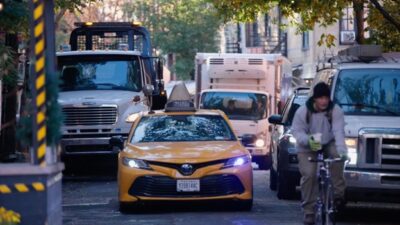
- Figure 5: Vehicles are an essential part of life.
-
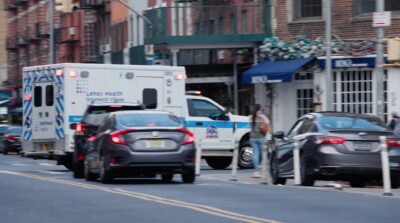
- Figure 6: Emergency vehicles need streets.
If we have to go long distances, or we need to carry heavy packages, we need vehicles. Even on a street like West 4th, vehicles are an essential part of life. They make everything work. Not just the trucks, vans or taxis but also the bicycles, scooters and motorcycles. In streets that are small, we do get a lot of congestion. The roadways are not that big and wide to allow fast-moving traffic. Small streets like West 4th are very walkable and at the same time can accommodate vehicles.
The ambulances, police cars and fire trucks must all have priority use of the streets. It is essential when pedestrians hear the sirens to pay attention and not be in the way and for cars to move over.
The sanitation truck is key. How are the buildings going to function if they do not have trash removed?
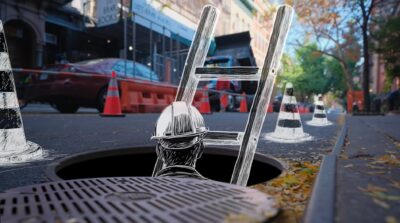
Figure 7: The world underneath the streets.
And then there’s the world underneath the streets. You cannot have buildings functioning without electricity. We need to take the waste from the buildings into the sewers. Our internet services have the cables under the streets. The city works because of what’s under the streets. You’re going to always see utilities being repaired, just like the buildings are always being repaired.
The city streets are where we get our light and air, where trees are able to prosper and contribute to improving the air quality. Because the provide shade, they encourage more walking. The street is where birds thrive, not just the pigeons but sparrows, wrens, cardinals and all else. There is a constant play of animal life including squirrels.
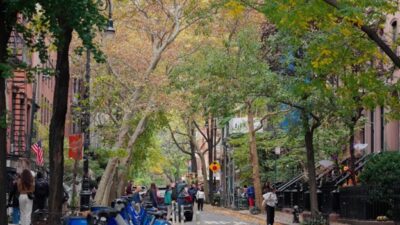
Figure 8: Trees provide shade on the street.
This is all part of an ecosystem that is contributing to our daily city life. In cities you are out in the street experiencing nature, the sun and the rain. Rain is when we have all those umbrellas come out and people trying to find room on the sidewalk go past each other lifting them up and lowering them – another kind of tug-of-war.
And then that snow comes. There is nothing more beautiful than how the snow falls on the sidewalks and on all the vehicles, the trees and the buildings with their canopies, balconies and window sills, and the trucks are plowing. Every property owner has to keep cleaning those sidewalks so people can walk and get out with their dogs.

Figure 9: Dogs need streets.
You cannot have a dog in a city without a street because where are they going to pee and poop? Every one of them is dependent on that street which is, by the way, where dogs get a chance to see other dogs. Certainly, walking your dog is a great way to meet other people because they all have to say hello to each other.
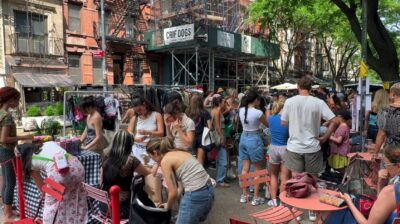
Figure 10: We have fun by closing the street.
Now, if you want to have a lot of fun, you close the street and have a block party. If you have a school and it’s on a block, close the whole street during school hours and, all of a sudden, the street will transform into fun, play and special events, celebrations and parades. Take Halloween: you cannot do trick-or-treating in the city without streets. We have lots of fun in the streets.
On West 4th Street, we have lots of restaurants, outdoor cafes and vendors with little food carts which are very movable, affordable and add a lot of color to life.
Shop fronts are always designed to induce you to leave the street and come inside. Some of the most successful streets in the world, especially in Europe, are straight and narrow like West 4th allowing you to window shop from both sides.
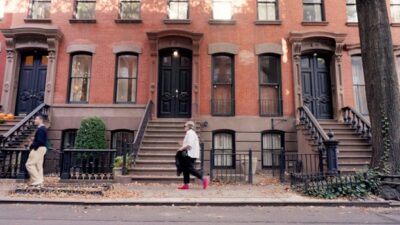
Figure 11: The look and feel of a street is based on buildings.
The look and feel of a street are based on the buildings. Their character and style, all those ornaments, decoration and architectural elements which come from the buildings, give us the visual experience and enjoyment of seeing so much. Cities are usually thought about as buildings tall and crowded together. While that may be true, it is the human scale that people experience. All the buildings of West 4th Street are small scale and the environment is very walkable and human. Think of West 4th Street as a model of streets in any city. The street (the space between the buildings) is the public realm. It includes all the functions of circulation whether walking or driving, all of the utilities that make everything work and all of the character and magic that makes a street great.
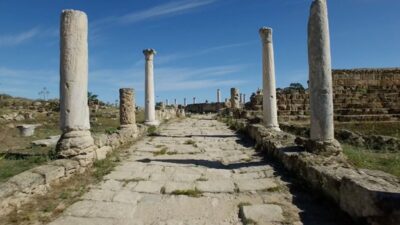
Figure 12: Streets have allowed civilizations to develop.
All cities throughout the world have streets. They have been the foundation of how civilizations develop and evolve.
Acknowledgements
This video is a Bagamore Media production for the Pittsburgh History & Landmarks Foundation. The accompanying transcript has been modified to suit this publication in Urban Design Review. All images are courtesy of Daniel Lovering, Bagamore Media.
END